









Welcome to ChrisLesso.com We’re currently in the process of renovations so please bare with us while we’re updating the site. Thank you.
Tuning Workshop
THINK LIKE A MUSICIAN, NOT A ‘DRUMMER’
If you have ever taken singing or piano lessons, this will help you! If you haven’t, don’t worry; just think musically! There is only one rule in tuning: THERE ARE NO RULES! Usually, the challenge in tuning is that you have an awesome sound in your mind, and you JUST CAN’T GET THE DRUMS TO SOUND THAT WAY! If this has happened to you, you are not alone! Every drummer has been there. Listed below are some common challenges that hold drummers back from achieving their great sound, and some tips and approaches from the greats. Remember, learn as much as you can, experiment, and create your own sound!
GENERAL APPROACH TO EACH DRUM
- Snare: Tune both heads fairly tight. Many drummers tune the bottom head slightly tighter. (Don’t tune the heads too tight or the drum will choke!) For the snares, start very loose, tighten the snares a quarter turn each time, then hit the snare to test it. Repeat the process until it is just enough snare buzz. Don’t worry if it buzzes, it will sound fine from the audience; let it ring! If it buzzes too much, a bit of muffling under the snares can help. Also, the frequencies of the toms sometimes sets off the buzz of the snare; try slightly changing the tuning of your toms, and see which one is the culprit!
- Toms: Make sure all lugs are in tune, and both heads are pretty close to the same pitch. Get the desired pitch from the batter head, and then match it with the resonant head. If you need to muffle, you may be using the wrong heads! Use minimal muffling, or let them ring!
- Bass Drum: Tune batter head tight enough that there are no wrinkles, then tune the resonant head slightly tighter. Use minimal muffling with small pillow of towel.
COMMON CHALLENGES
- Too tight or too low: A drum has a certain way it WANTS to sound! Just like your voice; there is a RANGE in which it is comfortable for you to talk, and everyone is different, JUST LIKE DRUMS! Many beginning drummers are outside of this ‘sweetspot’: If the drum is too loose or tight, it can never sound the best it can!
- Lugs not in tune: Every lug must be ‘in tune’ with each other to get a strong note from the drum, otherwise many frequencies are competing at the same time. Place the drum on a towel to mute the head you are not tuning. Unless you are just putting on the head, apply SMALL INTERVALS of tightness to every lug at a time. Distribute the tension to the drum evenly by tuning opposite lugs around the drum. (Don’t tune in a circle; criss-cross) THIS CAN BE CONFUSING, BE PATIENT! (Example: if a certain lug sounds out of tune, it may be the OPPISITE lug that needs adjusting!) Use a finger, mallet, or drum key to get a pure sound from each lug.
- Bad heads!: When is a good time to replace your heads? When they rip? There comes a time when the head is simply ‘worn out’, although it may not be torn. Dents in heads will also seriously affect the sound. If you are constantly denting your heads, it may be a technique challenge!
- Too much muffling: A drum is meant to sing and be heard! Would you put a towel over guitar strings? I have seen entire sleeping bags in bass drums; are they going to camp out in there?! Many drummers over muffle their drums, resulting in a weak, dead sound. On the other hand, sometimes a bit of muffling is OK! Observe the best drummers: most of them let the drums sing, and get out of the way. Instead of smothering your drums natural sound, work on the skill of experimenting different tunings to bring your drums to life!
- Sounding good as a unit: Drums can sometimes sound great by themselves, but not sound good AS A UNIT! Here’s a tip from Jeff Salem: Remember that horn tune that opens the horse races? Those intervals can be a great guide to help your drums sounds great as a unit! On a 5-piece kit, start on the bass drum, play the tune working up to your small tom. Does it sound close? Work from there, and make any changes you like, keeping in mind how they sound together as a team!
- Ignoring the bottom head: DON’T FORGET THE BOTTOM HEAD! This is called the resonant head, and vibrates by air moving to it when the batter head is struck. This head has a huge effect on your sound! Here is a general approach: Snare:have the bottom head pretty tight, but not choked (over tightened). Many drummers have this tighter than the batter head. This will bring your snare to life! Toms: If the resonant head is tuned to the same pitch as the batter, the tom will have a nice tone. Some drummers prefer the resonant head to be SLIGHTLY tighter or looser than the batter. Experiment, and find your own voice!
Staying in tune: KEEPING the drums in tune is a challenge by its self! Here are some things to keep in mind:
- Extreme heat and cold, moisture and dryness are not good for your heads or drums! In the old days it was worse with calfskin heads, but temperatures can still cause your heads to expand and retract.
- Always make sure to ‘lock’ your lugs slightly when loosening a lug. This will add tension, and prevent the vibrations from loosening your head.
- Always stretch new heads. The crackling sound is OK!
- One more thing, remember your drums will always sound different depending what room you are in! You just have to depend on your ears!
TIPS AND SUGGESTIONS
Detective Work: Make a list of your three favorite drummers, and find out how they tune. You may have to use your imagination in how to find out. Use email, books, library, chat sites, videos and DVD’s, etc. All you have to do is STEAL their methods and see what happens! You will either like it or not! Check out this handout for some great drummers tips!
Keymaster: Use two keys to speed up the process! (Invest in many keys!)
A New Perspective: Try tape recording, video taping, or have someone else play your drums while you stand back. For example, John Bonham used to have his son sit behind the kit and play, while he would walk around the hall and listen to the drums! Sometimes how the drums sound from behind the kit, is not how it sounds to the audience. Whatever way you can, get a new perspective!
Take the high or low road: Some drummers tune in the higher range, like John Bonham, Stewart Copeland, and Travis Barker. This gives the drums a bright, sharper tone. Other drummers like John JR Robinson (Studio great) and John Tempesta (White Zombie, Helmet) both tune just above the wrinkle point to get a low fat sound. Experiment, and find the way you prefer! Remember:serve the music first!
To Muffle or not to Muffle: A little muffling can be a good thing, as long as it doesn’t interfere with the natural sound of the drum; remember you want ENHANCE the sound of the drum! A technique used by many drummers is the ‘accordion’ taping style: take a piece of duct tape, not too big, and add small 3 or 4 small folds. Stick it to the corner or a snare or tom. Don’t overuse it; start small!
Learn to tune a Guitar (without a tuner!): This will help develop your EAR! Hearing is everything! This will also help develop your sense of pitch. (How high or low a note is) Piano or singing lessons will also give you a huge advantage!
Bullseye: To get the fullest tone out of the drum, strike it in the dead center of each drum. (There have been drummers that have used chalk circles, or coins taped underneath the heads to train themselves to hit the exact center of the drum!) Watch the way precise players like Neil Peart and Mike Mangini play to see this in action.
More choices: The type of heads and sticks you choose to use will also play a big part. Even a different room will change the sound of your drums! Just remember to ALWAYS SERVE THE MUSIC FIRST!
RESOURCES
How to Develop Your Sound, Video, by Dave Weckl
Drum Tuning Sound and Design, Video, by Bob Gatzen
The Drumset Crash Course Tuning, DVD, by Russ Miller
Drum Tuning, The Ultimate Guide, Book, by Scott Schroedi
TIPS FROM THE PROS
I use single ply heads – either clear Ambassador or coated. I prefer clear. I tune the top and bottom head exactly the same and much higher than people think. This translates better and sounds deeper once miked – much more tone. For snares, tune the bottom head fairly tight but evenly. Make sure the snares are centered on the head and don’t over tighten them. Tune the top head evenly and also fairly tight. Don’t worry about the ring – let it ring. For the Bass drum, tune the batter head as low as you can without any wrinkles – the front head a little tighter. Dampen the front head if you have too much ring. Try these ideas, see how it sounds, and use your ears to judge. It will take years of tuning and playing to get a great sound but that’s what it takes. Each drum is a little different too!
Simon Phillips (The Who, Toto)
When tuning around the head, trying to balance the pitch adjacent to the tuning bolts, use a softheaded mallet instead of a stick. It takes all the attack out of the sound and makes it much easier to hear the pitch. As you tighten the bolt you can hear much more easily the head coming into tune. Also, when tuning double headed drums, rest the drum on a folded towel to eliminate the sound of the head you aren’t tuning. This works better if the drum is on the floor (instead of a table).
Thomas Howie (Various Top 40 and Gospel bands)
Place your finger in the exact center of the head WITHOUT PRESSING, and then tap the lugs. This will give you a ‘harmonic’ sound, similar to what guitarists use. Sometimes using this method makes it easier to hear the pitch of the lug and be precise!
Mike Mangini (Steve Vai, Extreme)
To muffle your floor toms, place between 6 and 12 cotton balls inside the drum. As the drum is struck, the balls get thrown in the air, they then fall down resting on the bottom head and cutting off the ring.
Shannon Larkin (Godsmack)
Always use your left hand to tune, to challenge and strengthen your weaker side!
Dom Famularo (Clinician)
All Limbs Equal: The Drumset within a Drumset
I believe traditional grip is dead… it’s not functional, it’s not strong, and it’s not natural! Let’s see it for what it is: an outdated technique designed to adapt to an old (and now nonexistent) challenge of how the heck do you play a tilted snare drum hanging around your neck back in the days of military snare drum marching. Although the drumset is a very young instrument at around 90 years, it’s come a long way since then!
However like most debates, it’s not always black and white. The best case for this technique I heard from my drumming hero Tony Williams, who played traditional grip enthusiastically. The concept was so good, that I (very) briefly considered adopting this grip, and ‘making the switch’. What I found so compelling was the ‘a-symmetrical’ idea that when you play traditional grip you use different muscle groups in each hand, therefore ‘stimulating’ the brain to think of different, more creative ideas than would have been conceived with the ‘boring’ symmetrical match grip. So what I propose is taking this idea into the next chapter of the instrument, but in completely new and different way.
All Limbs Equal
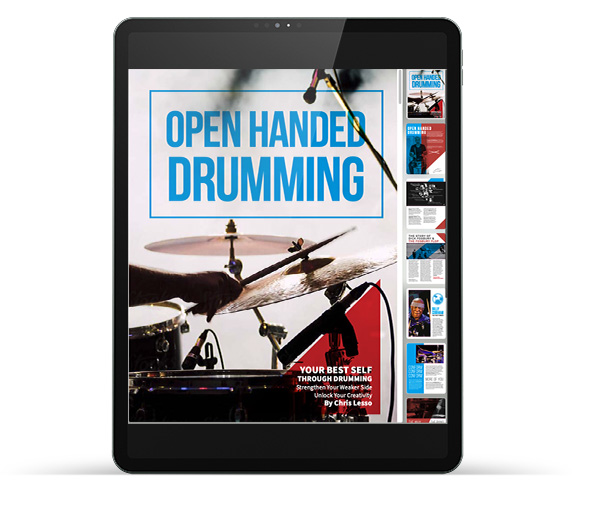
This is the ‘All-Limbs-Equal’ approach which really is virtually impossible to attain, but is the only worthwhile goal to shoot for! The way the average right handed player approaches the drums (playing cross handed style) actually makes the already strong limbs stronger, leaving the weaker limbs in the dust. Even if you prefer this classic approach to the drumset, the ‘all limbs equal’ goal should still be there. A chain is only as strong as its weakest link, and your idea is only as strong as your limitations. Steve Gadd, because he has a great left side, was able to give Paul Simon what he asked for when creating the hybrid groove in ‘50 Ways To Leave Your Lover’, which adds the left foot hihat and left hand in an open handed style. ‘Openhanded’ on the drums means ‘no crossing the hands unless it looks cool in a solo’. I started using this approach about 7 years ago, and I am still working on it! What really inspired me was seeing my teacher Dom Famularo challenging himself with this new world of drumming by actually sawing off his hihat stand to keep it from going too high. This prevented any crossing over, so he simply had to relearn with his left hand leading the grooves!
Drummer Within A Drummer
The real fun starts once you have even a little control over your left side: you start to create the ‘drummer within a drummer’ feel, or 2 drumsets in one. Since this world has opened up to me, I now have a hihat and ride cymbal on my right and left side. I find that some grooves feel better on the right, and some better on the left, almost like I have a split personality! I have advantages one way, and some the other way. Like the Tony Williams theory, I have a different sense of creativity with each side. The way my left feels to lead, the feedback my body and brain are getting, gives me a whole new stimulation, therefore allowing me to create different ideas. This opens up a new dimension of possibilities!
The next step is one that I have not tried but will be something I’d like to try: many drummers are now adding a hihat pedal on the right side as well as the normal left. Now you can play bass drum lead or the hihat with either foot, creating the ‘drumset within a drumset’; now you literally do have a righty and lefty set at your command. Check out Mike Mangini for someone that’s been developing this for years!
Teaching
Even before I started applying this to my own playing, I realized the effect that teaching very young students this approach would have, and the results were astounding! I continued to stick with my comfortable dominant right side, but taught ‘all limbs equal’ with some eager students. With my own playing I had to fight uphill ‘relearning’ how to play with my left side, and still am, but my young students had the advantage of doing this from day one and didn’t know anything different. Once the brain accepts leading with either hand or foot, lookout! The ultimate goal is to hear an idea in your mind and execute it with no ‘blockage’. Expression should know no bounds!
And Beyond…
To really see where this will take the instrument will be up to future drummers. What really matters and is most important is making MUSIC: what is your overall sound you are creating? We are sound crafters with a powerful instrument to do it with. ‘All Limbs Equal’ will tap into many more possibilities with this young instrument!
New School Drumming
Reflections on My Craft From the Vantage Point of Touring
Expanding the Paradigm
“There are no rules, only possibilities.”
One of my biggest inspirations for what I do is Bruce Lee. As far as I know he has never hit plastic and metal with pieces of wood… drumming that is! Why not draw on sources completely outside the so-called walls of your chosen craft? Mr. Lee would use ANYTHING possible to streamline his expression, from any area. I have many ‘greats’ that inspire what I do in this way: everyone from of course Bruce, to Eddie Van Halen; from Miles to Picasso!
It was in this mood that I was watching a Victor Wooten Clinic. (What a great way for a drummer to spend time, checking out a bass clinic!) At the clinic he mentioned a great concept, what he calls ’2 through 10′. What it means is this; let’s take ten important tools we need to make music. Notes would be the first most people mention, and of course they get all the attention; just look at any method book! (Or like the guitar player Walter Trout proudly wrote on the back of his T-shirts: ‘Too Many Notes and Too Loud!’) So what would the other elements be? Before you read on, stop and make your own list! Well, what are they?!?
Vic didn’t say what he thought were the other 9, which makes this wide open to add any concepts OTHER than notes that you think are vital to music. I really was trying for a short, simple, ‘right to the point’ list, but after a few New York minutes, this looked more like one of my grocery receipts… but this is good! It’s an extremely creative state of mind too get into; a good debate, and definitely a great musical brainstorm! After some pondering and whittling down, I’m naming my version ‘2 through 12’. Here’s my list: (*not in order of importance!)
1) Notes 2) Dynamics 3) Touch 4) Tone 5) Space 6) Choice 7) Mental State 8) Time 9) Form 10) Listening 11) Rhythm: Styles and History 12) Technique
Jumping from country to country in the self-contained pressure cooker of a tour can be a great tool to take a good look at what I’m doing, how I do it, and how I can draw from a wider pool to have more to offer.
Watching ‘2 through 12’ from the tour bus window…
“I like pleasure spiked with pain; and music is my aeroplane…”
If you could name one of THE most effective tools for improving in music, what would it be? What I’ve heard so many of the ‘heavyweights’ say, and what I’ve personally found to be the most potent (sometimes painful/ always humbling!) is RECORD YOURSELF! Like the drummer Billy Ward said: (one of my favorite quotes) “Put yourself through what you are putting the audience through!” Think of the root word of ‘audience’… AUDIO! Drums are freakin’ LOUD and demand attention, so… what kind of attention are you getting? What are we ‘forcing’ others to experience through our sonic conversations… are we talking substance or hot air?
Well, I got the opportunity to do this repeatedly on tour. Really, what better time is there? Every show of a tour is like walking into the boxing ring… you KNOW you are going to be challenged, to sweat, to dig deep; to give what you didn’t think you had; to play the show like it will be your last on earth. With so many shows, and so many chances to analyze what I do in this crazy job I have (like my teacher Dom Famularo said: “I hit metal and plastic with wood for a living: If I organize that noise, I get paid!”) I have learned so much about my strengths and weaknesses (I have many of the latter!:) through watching the shows the next day on video. Here is some of what I have learned, tied in with my own choices of ’2 through 12′:
1) Notes
I play a lot of these… too many usually! I think it was Dizzy Gillespie that said that as he got older, he learned what NOT to play. It’s always really interesting to do a ‘through the years’ look at your favorite player; everyone always gravitates towards QUALITY not QUANTITY over time, as we are always constantly refining what we do, discarding the unnecessary. Could I say what I needed to say with less notes? After watching myself play, I usually have to answer YES to this… but I’m working on it!
2) Dynamics
The best advice I got about this was when I was a kid (at first reluctantly) studying the piano: EXAGERATE the dynamics; this creates emotion and excitement! There have been times when I’ll either go much quieter or louder than I think is needed, and the result on tape is that it ends up making the music better. I think because the artist is going to the extremes and taking a RISK… and making the interaction way more exciting! And besides, what’s the best way to keep people on the edge of their seats? Not redundantly pummeling eardrums with volume, but playing really really REALLY quietly… try it!
3) Touch
Jojo Mayer called this is the new frontier of drumming. Touch to me is a result of everything your body is doing IN BETWEEN the notes. How you Move is how you Sound! Playing other instruments will definitely give you more of this… think ‘Beyond the Cymbals’! Whatever medium draws you most, the goal is always to work with nature, not against. In drumming, this is about using rebound and economy of motion. I see this as that kind of metaphysical, mysterious, ‘personal fingerprint’ area of drumming that is fascinating! I am definitely still working on this, and it is easy to see on tape when I try too hard, or not enough, and see how motion DOES affect sound. It’s how the wood of the stick moves IN BETWEEN the moments of actually striking the drum which defines your sound. (Whoa, that’s DEEEEP!!) Touch is what makes you sound like… well, YOU!
4) Tone
What affects Tone? I think of this as the overall ’round sound’ emanating from your chosen axe: this is created by your touch, the wood of the instrument, the heads, (and condition of them!) the room you are in, and the ever-challenging subject of Tuning!! In other words, the total end result of all those DETAILS we worry about. (‘God is in the details!’) How are the drums relating to each other and the other instruments? Where do all the frequencies sit? Without the mental onslaught of a performance to worry about, without the physical stamina testing our endurance, we can sit back and watch the screen and observe where our instrument sits in the scheme of things. I’m always trying to improve my tone, and always checking out the greats in this area: from Stevie Ray Vaughan to Sinatra! (I know they’re not drummers, that’s the point!)
5) Space
I admit it, I have had my moments of terror onstage: from space! I think some great advice is: think like a wind instrument… one that has to BREATHE! On the drums, we can ‘hit stuff’ for a very long time… we of course need to breath as well, but we can keep hammering eardrums at the same time without stopping. (Now that’s power!) This is great for the endurance sport ‘Guinness-book-record-breaker-seeker-drum off’ type displays, (no music.. or girls allowed!) but wind instrument players are forced to breathe between phrases. (Or like taking a breath before talking…like a conversation!) We drummers can learn from this! I love hearing this musical approach in drummers I admire, and try to match this impression and effect when hearing the all revealing / almighty ‘gig tapes’. I remember meeting someone recently, and they were saying way too many words, breathing way too shallow, talking way too fast without any breaks at all… I very quickly and easily lost the message he was trying to convey. I don’t want my drumming to sound like that!!
6) Choices
“You know what I do when I think of a great fill? I don’t play it!” That’s a quote by Steve Ferrone, the groove-layer-downer for Tom Petty’s Heartbreakers band. Choices, choices; what do I play, when do I play it… and what I find myself sometimes demanding of the screen out loud when watching a tape of a show…”now WHY did I do that?!?!” Hopefully the answer is it was for the purpose of the song as a whole, and communicating something meaningful in the right place. Make every note count! I want to see myself taking risks, but I want to see a reason behind my choices; was I responding to an idea, supporting an idea, setting up an idea? This is where Form and Dynamics comes in; what’s the big picture saying to me, and how am I responding and contributing to that? Or did I just fall into the trap of playing the amazing, ever-impressive, elusive ‘great fill’ just for the sake of, well, playing a fill…. hmmm, I wonder if other drummers have also been guilty of this?? (Yup!)
7) Mental State
This is a big one! What to think about? What NOT to think about? Wait a second… am I thinking about not thinking?? How NOT to think?!? When does it help, and when does it corrode our focus, taking all the damn FUN out of it? I have learned that IF I FEEL GOOD, THEN I WILL PLAY GOOD. I saw the movie ‘The Last Samurai’ where Tom Cruise’s character discovered the Japanese concept of NO MIND… could this help in drumming, in music? Whatever you are channeling, LET it come out, or in other words GET OUT OF THE WAY! You could say this is the ‘Zen’ of drumming. This is about getting into The Zone… you’ll know it when you are there, it’s why we do this in the first place! Mediation and Yoga have really helped me here. (Remember breathing?) But how far do we go in using the mental microscope? Getting in the ‘over-analyzing’ state of mind can be a creativity killer! (It’s happened to me, and can be slightly paralyzing!!) Or, how about we simplify this paragraph down to 5 words: If you Think, you Stink!
8) Time
What I noticed painfully quickly after starting to listen to my playing on tape is: if the elements of strong Time and Rhythm are not there, any idea played becomes meaningless. No matter how supercool/hip/genius/impressing-the-chicks-in-the-front-row/etc. that our idea is, without good strong time, it’s ruined!! Time is THE BIG ONE; what all the other ‘2 through 12’ concepts orbit around. It can be the subtle shades; it can be the glaring mistakes. The best way to feel time is to BE time; keep the body MOVING to the pulse! What works for YOU? I’ve seen all kinds: head bobbers, heel shakers, hip swayers, it doesn’t matter; MOVE! Buddy Rich once said: “I don’t play the drums, I dance the drums!”
How we FEEL affects Time (this is also #7 ‘Mental State’… it’s cool how they all tie together and overlap!) The adrenaline state of performing onstage is definitely different than the experience being in an audience; perceptions of time in different situations can be totally different. You want to be a time traveler? You already are! Just think of the difference between a roller coaster ride, or say, a doctor’s office wait. Did I just have a rocket-fuel Starbucks Columbian Coffee, or a big lazy meal? Am I extremely rested, or unrested in the extreme? When the adrenaline is pumping in that drum seat, what I feel is slow from the stage can be really fast from the perspective of the audience! (And we all know drummers are a little, well, high strung to begin with…. wait, and we’re asking these individuals to beat objects with wood sticks??) Japanese drummers have a concept called ‘Ma’ which means the intervals of time and space felt between each note. I’m always trying to strengthen my focus on that strong heartbeat pulse that is the essence of what drumming is all about, as well as the spaces in between. Let it breathe! If you are physically breathing, your music will also breathe… don’t be all tight chested and tense… it’s only MUSIC after all, don’t take it too seriously! Your mistakes won’t actually kill anybody; unlike, say the mistakes of a Pilot! Surrender to time, to the pulse; it all revolves around the Quarter Note. Think RELAXED INTENSITY!
9) Form
See the big picture! Convey it, animate it… get it across the gap to the audience’s hearts and minds! I think of this like a conversation… what’s the theme? Does it all tie together? Do my ideas complement each other, or am I rambling? On tape, I can tell right away if I’m thinking in choppy segments, or in one entire flowing piece. Think of a great movie: this involves building up tension, foreshadowing, setting up scenes, excitement, restraint… was something communicated to the average person listening? I need my fills to RELATE to the section I’m setting up. I need to think of the entire piece, not just the fragments. I need the ‘bird’s eye view’ map of the tune in my minds eye. I think charting songs and visually seeing them is the best for this!
10) Listening
Meditate on this:
Listen… React… Listen…. React.
What is the difference between Hearing and Listening?
Absorb… Respond… Observe…. Contribute.
(What was that you just said? What?!?!)
11) Technique
Simply put: the HOW of any skill. Danger: Obsessing over this aspect. The truth: This is only a MEANS to and END. Quitting is not an option: Technique takes much Patience and Perseverance to acquire, two other subjects that I could have added to my list. Playing it back: Videotaping especially, is the best way to see your technique laid bare for all to see including YOU (all your good and bad habits!) and how it affects your SOUND (always keeping the END in mind!)
12) Rhythm: Styles, and History
Steve Smith has a great phrase for this… ‘Standing On The Shoulders Of Giants’. We must first assimilate before we can innovate… study the masters! I know that if I study any language thoroughly, I’ll express myself with so much more clarity and intensity, bringing my own personal stamp out easily. If we all went and decided to study our native tongue English again (never mind a whole other language!) I’m sure we could all craft our ideas and convey our experiences much more accurately… with the soul and character of our message intact. What am I saying? Why did I say it? What ‘language’ am I speaking in? This is how we articulate what is in our hearts, what we mean to convey, to communicate; it truly is an art. What am I using as a launching pad for my own creativity? I love tapping into uncharted territory, either music that is new to me from the past, or different styles around the world my ‘northern ears’ aren’t used to hearing. This is always growing!
Paying it Forward: Looking Ahead
“The kind of person we are, is the kind of artist we will be.”
Everything we do, eat, read, experience, think about, etc. will affect how we play. Whatever we bring to the music will affect the overall FEEL of the music; the sum total of all our elements, the final product of what we have to offer! The theme of this article is really about self-reflecting, while at the same time Thinking Outside the Box! (and having a damn good time of it as it’s happening!!) I found it challenging to narrow this list down to 12. I could easily make another different list right now… that’s what is fun about this exercise! Here are some casualties that I didn’t include, but are also really rewarding to think about: Fearlessness, Unpredictability, Melody, Phrasing, Attack, Physical Conditioning, Performing, Confidence… but I’ll leave you to decide what makes this list grow! (2 through 99?)
Whenever I sit down and play, I strive to give the music to all I can in that moment… drawing from all I possibly can in that sacred instant. Hearing myself play it back is humbling, always showing me what I do and DON’T know! This is when I can see the spectrum of these concepts and how they all inter-relate, and how it all fits together into what I can offer the ensemble, hopefully continuously evolving all the while. There is a philosophy in Japan based on how to approach ones life’s work, called ‘Kaizen’; this translates to mean ‘Constant and Never-Ending Improvement’. It is because it is forever unfinished and imperfect that we are always striving for that next plateau; this is the joy of what we do! We will find inspiration, joy, frustration, passion, fulfillment, satisfaction, anger and love in this journey, not just in the destination…. which never really arrives anyway! Isn’t that what a worthwhile quest is truly all about?